Cricket Betting Strategies: A Practical Guide to Smarter Decision-Making
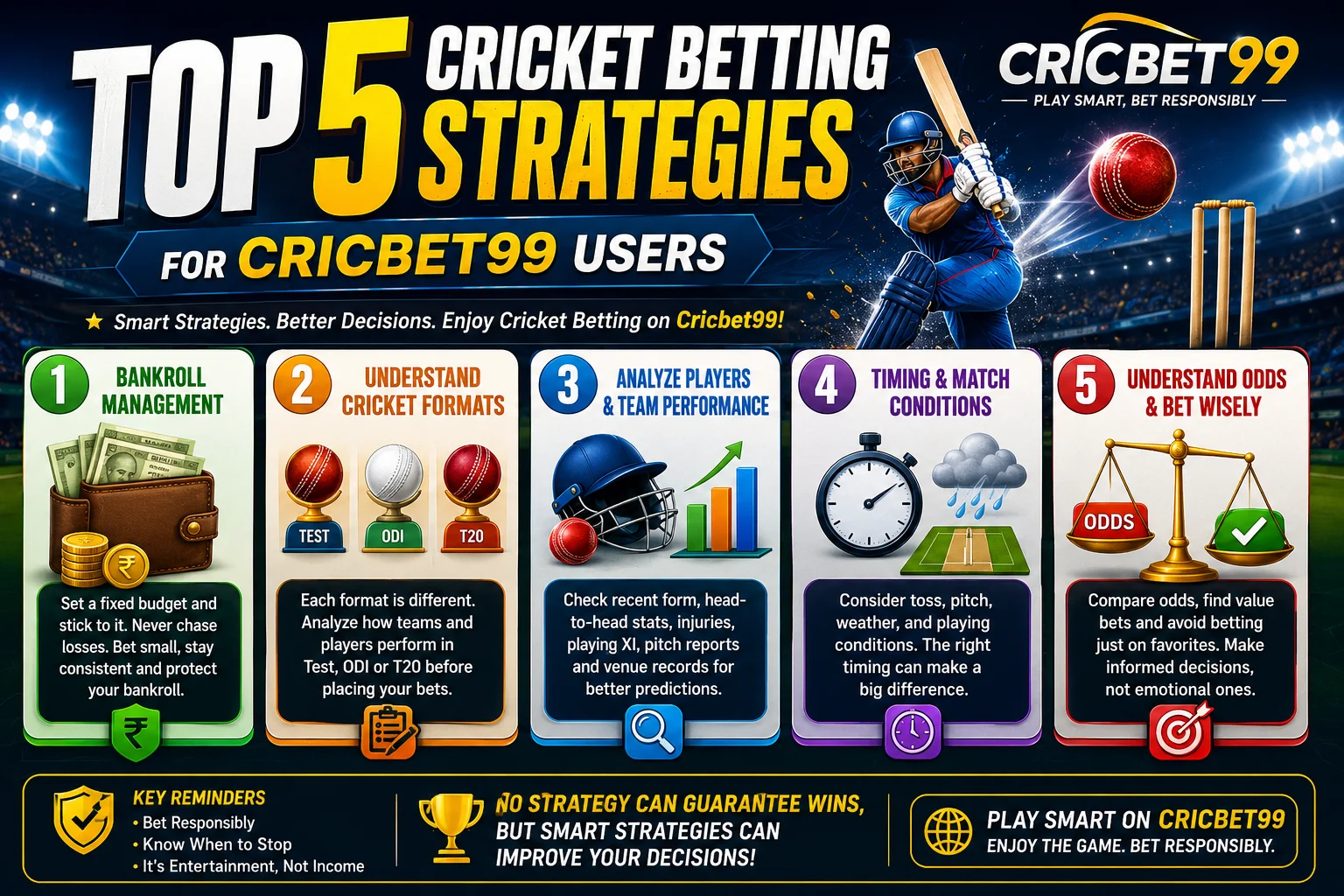
Top 5 Cricket Betting Strategies for Cricbet99 Users
Introduction
Cricket betting can look simple at first: choose a team, select a market, enter a stake, and wait for the result. In reality, crexbet99 contains many variables that can influence an outcome, including pitch conditions, weather, player availability, toss results, team balance, recent form, and the format being played.
For anyone using a cricket betting platform such as Cricbet99, understanding these factors is more useful than simply following popular teams or reacting to short-term results. A disciplined approach starts with learning how different cricket formats work, studying reliable information, setting a fixed entertainment budget, and accepting that no strategy can guarantee a profit.
The International Cricket Council recognises three major international formats: Test cricket, One-Day Internationals (ODIs), and Twenty20 Internationals (T20Is). They have very different characteristics, which means information that matters greatly in a T20 may have considerably less importance in a Test match.
This guide explains five useful principles for understanding cricket betting markets more carefully. The emphasis is on analysis and responsible decision-making rather than promises of winning.
1. Start With Bankroll Management
The most important principle is not predicting the winner. It is controlling how much money you are prepared to risk.
A betting bankroll should be treated as a separate entertainment budget rather than money needed for rent, food, education, bills, savings, or emergencies. Once that budget is gone, betting should stop.
Set a Fixed Budget
Suppose someone decides that ₹5,000 is the maximum amount they are comfortable spending on betting entertainment during a month.
Instead of putting a large portion of that amount on one match, they could establish a much smaller standard stake.
For example:
- Total entertainment budget: ₹5,000
- Typical stake: ₹100–₹250
- Maximum planned exposure on one match: ₹250
- No borrowing to increase the bankroll
- No additional deposit simply because earlier bets lost
The exact amounts are personal choices. The important point is consistency.
Avoid Chasing Losses
One of the biggest problems in gambling occurs when someone loses a bet and immediately increases the next stake to recover the money.
Imagine a bettor loses ₹200 and then decides to stake ₹400. If that bet loses, the next stake might become ₹800. A short sequence of losses can quickly become financially uncomfortable.
A Cricbet99 better approach is to accept losses as part of the activity and keep stakes within the previously established budget.
Keep Records
A simple record can include:
| Information | Example |
|---|---|
| Match | Team A vs Team B |
| Format | T20 |
| Market | Match result |
| Stake | ₹200 |
| Result | Loss |
| Reason for decision | Recent team form |
| Notes | Key player unavailable |
Records are useful because they show whether decisions are based on evidence or emotion.
2. Understand the Cricket Format Before Studying a Match
A common mistake is treating every cricket match in the same way.
Test cricket, ODI cricket, and T20 cricket have different structures and require different skills. The ICC describes Tests as five-day matches with two innings per side, ODIs as 50-over matches with one innings per side, and T20Is as 20-over matches with one innings per side.
Test Cricket
Test matches place considerable importance on:
- Batting technique
- Bowling endurance
- Conditions over several days
- Swing and seam movement
- Spin as the pitch changes
- Batting depth
- Weather interruptions
A team that struggles in the first session may still have several days to recover.
ODI Cricket
ODIs sit between Tests and T20s.
Important considerations can include:
- Opening partnerships
- Middle-order stability
- Death-over bowling
- Run-rate management
- Wicket preservation
- Bowling resources
- Conditions during both innings
A strong ODI team generally needs balance rather than relying exclusively on one specialist skill.
T20 Cricket
T20 cricket is much shorter, meaning individual events can have a larger effect on the final result.
Useful areas to study include:
- Powerplay batting
- Powerplay bowling
- Six-hitting ability
- Middle-over spin
- Death bowling
- Finishing ability
- All-rounders
- Recent player roles
The ICC describes T20 as the shortest and fastest of the three major international formats, generally lasting around three hours.
Practical Example
Imagine a team has excellent Test-match batting statistics but has recently struggled to score quickly in T20 matches.
Using its Test reputation alone to judge a T20 match would be misleading.
The better question is:
How does this team perform under the specific conditions and demands of this format?
Understanding the format therefore becomes the foundation for further analysis.
3. Analyse Players and Teams Using Recent, Relevant Information
Past reputation can be useful, but it should never replace current information.
A famous player who has performed brilliantly for years may still have an ordinary match if they are carrying an injury, facing difficult conditions, or playing a different role.
Look Beyond the Last Match
One match is rarely enough to establish a meaningful trend.
Instead, consider a wider sample of recent performances.
For a batter, useful information might include:
- Recent runs
- Strike rate in T20 cricket
- Performance against particular bowling types
- Record at the venue
- Powerplay performance
- Recent batting position
For a bowler:
- Recent wickets
- Economy rate
- Overs normally bowled
- Performance against particular batters
- Powerplay or death-over role
- Bowling style and conditions
Team Information Matters Too
Player statistics are only one part of the picture.
Also examine:
- Recent team results
- Expected playing XI
- Injuries
- Suspensions
- Squad rotation
- Home and away performance
- Batting depth
- Bowling depth
- Recent tactical changes
For example, if a team’s main opening batter is unavailable, its entire batting structure may change.
Similarly, losing a specialist death bowler can significantly alter a T20 team’s strategy.
Use Multiple Sources
Avoid relying on one social-media post or prediction account.
Compare information from sources such as:
- Official team announcements
- ICC information
- Official competition websites
- Reputable cricket statistics providers
- Established sports journalism
The ICC maintains official playing conditions and competition information, which can help confirm rules and format details.
Practical Example
Suppose Team A has won four of its last five matches.
That sounds impressive.
But deeper research might reveal that:
- Three victories came against weaker opposition.
- The team is missing its leading spinner.
- Its next match is at a venue where it has historically struggled.
- Its opponent has a strong record against its top-order batters.
The simple win-loss record therefore tells only part of the story.
4. Pay Attention to Timing and Match Conditions
Cricket information changes rapidly.
A prediction made six hours before a match may become less useful after the toss.
This is particularly important because the final playing XI, pitch conditions, weather, and batting order can all influence expectations.
Before the Toss
Before the toss, useful information includes:
- Expected playing XI
- Injury reports
- Recent form
- Venue statistics
- Weather forecast
- Pitch characteristics
- Team balance
However, some important information may remain unknown.
After the Toss
The toss can provide additional information.
You may learn:
- Which team is batting first
- Whether conditions are expected to change
- Whether a team has selected an extra batter or bowler
- The final playing XI
- The captain’s assessment of the pitch
This does not mean the toss determines the winner. It simply provides another piece of information for analysis.
Live Matches Require Extra Caution
Live betting can be particularly difficult because markets can change rapidly.
A six, wicket, injury, dropped catch, or change in weather can alter the perceived situation within seconds.
Some platforms advertise live markets and rapidly changing odds. Cricbet99’s published FAQ, for example, describes live cricket markets and warns users that odds can change quickly.
For responsible decision-making, never feel pressured to place a bet simply because an opportunity appears for a few seconds.
Avoid Emotional Reactions
Suppose your preferred team loses two wickets during the powerplay.
A common emotional reaction might be:
“They are going to lose. I need to bet on the other team immediately.”
That is not analysis.
Instead, ask:
- How many overs remain?
- What is the current score?
- Which batters are at the crease?
- How strong is the lower order?
- What is the pitch doing?
- How has the opposition used its bowling resources?
Sometimes the situation is genuinely difficult. Sometimes a team can recover. The important lesson is to separate observation from emotion.
5. Compare the Market With Your Own Assessment
Understanding odds is essential before participating in any betting market.
Cricbet99 Odds represent the market’s assessment of an outcome and determine the potential return according to the applicable market rules. They do not represent certainty.
For example, imagine a hypothetical market offers:
- Team A: 1.70
- Team B: 2.20
A beginner might simply assume Team A is “more likely” and immediately select it.
A better analytical process is to ask why the market has produced those prices.
Consider the Underlying Reasons
Research might reveal:
- Team A has stronger recent form.
- Team A is playing at home.
- Team B has lost an important bowler.
- Team B’s top order has struggled recently.
Those factors may support Team A’s position.
But perhaps another analysis reveals:
- Team A’s victories came against weaker teams.
- Team B has an excellent record at the venue.
- The pitch strongly favours the bowling attack.
- Team A has an injury concern.
The market price should therefore be considered alongside independent research rather than accepted blindly.
Back and Lay Markets
Some cricket exchanges provide both “back” and “lay” options.
In simple terms:
- Back: You are selecting an outcome to happen.
- Lay: You are taking the opposite position on that outcome.
Cricbet99’s published FAQ describes its exchange markets using this back-and-lay structure.
Beginners should understand the financial implications of both positions before using them. Exchange betting can involve more complicated outcomes than a straightforward match-winner selection.
Don’t Bet Every Match
One of the most useful habits is recognising that no bet is also a decision.
There may be matches where:
- Information is incomplete.
- The playing XI is uncertain.
- Weather creates major uncertainty.
- You do not understand the competition.
- The odds do not appear attractive relative to your assessment.
- You are already emotionally invested.
Skipping such a match can be a sensible choice.
Putting the Five Principles Together
The five strategies are most useful when combined rather than treated as isolated tricks.
Consider this hypothetical T20 match:
Team A vs Team B
Step 1: Check Your Budget
You have already established a fixed entertainment budget and a small maximum stake.
You do not change that amount because the match appears important.
Step 2: Identify the Format
It is a T20 match, so you focus on short-format factors such as powerplay performance, middle-over bowling, finishing ability, and death bowling.
Step 3: Study Current Information
You review:
- Recent results
- Player availability
- Expected line-ups
- Recent batting performances
- Bowling performances
- Venue statistics
Step 4: Wait for Relevant Information
The toss takes place.
You confirm the final playing XI and consider whether the decision to bat or bowl changes the match conditions.
Step 5: Compare Your Assessment
You look at the available market and ask whether the information you have actually supports your assessment.
If uncertainty remains high, there is no requirement to participate.
This process is much healthier than simply searching for a “sure win.”
Common Mistakes Beginners Should Avoid
Following Tips Blindly
Prediction groups and social-media accounts can be entertaining, but nobody can guarantee the result of a cricket match.
Treat outside opinions as information rather than instructions.
Betting Because a Team Is Popular
Popularity is not evidence.
A famous team can lose, while an underdog can perform exceptionally well.
Increasing Stakes After Losses
Losses should not automatically trigger larger stakes.
Chasing losses can turn a manageable entertainment activity into a serious financial problem.
Ignoring the Playing XI
A missing star player can change a team’s balance considerably.
Always check confirmed team information when available.
Overreacting to One Over
T20 cricket contains rapid swings.
A team can concede 20 runs in an over and still recover. A team can lose three wickets and still produce a competitive total.
One event should not automatically determine your entire assessment.
Betting While Angry or Excited
Emotional decisions are often less disciplined.
If a match is causing frustration, excitement, or pressure to recover previous losses, taking a break is the safer choice.
A Simple Pre-Match Checklist
Before making any decision, consider:
- Have I set a fixed amount I can afford to lose?
- Do I understand the match format?
- Have I checked recent team performance?
- Have I checked player availability?
- Have I considered the venue?
- Have I checked relevant weather information?
- Do I understand the market?
- Have I considered the odds rather than simply choosing a favourite?
- Am I making this decision based on information rather than emotion?
- Am I comfortable losing the entire stake?
If several answers are “no,” waiting may be preferable.
Responsible Gambling Should Come First
Betting involves financial risk, and there is no strategy that guarantees consistent profits.
A responsible approach means:
- Only participating where permitted by applicable law.
- Following the platform’s age requirements and terms.
- Using money that you can afford to lose.
- Never borrowing money to bet.
- Never using essential household funds.
- Taking breaks.
- Avoiding attempts to recover losses through increasingly large stakes.
- Seeking help if gambling becomes difficult to control.
Cricbet99’s published website also states that users should participate only where online betting is legally permitted and identifies responsible gaming as an important consideration.
Indian gambling and gaming rules can differ according to jurisdiction and activity, so users should independently verify the laws that apply to them before participating.
Conclusion
There is no secret formula that can turn cricket betting into a guaranteed source of income. The most useful approach is to become a better-informed observer of the sport while maintaining strict financial limits.
The five principles covered in this guide are:
- Manage your bankroll carefully.
- Understand the differences between Test, ODI, and T20 cricket.
- Analyse current player and team performance instead of relying on reputation.
- Pay attention to timing, toss information, line-ups, and changing match conditions.
- Understand odds and compare them with your own assessment rather than following the crowd.
For beginners and intermediate cricket fans, these habits can make match analysis more structured and enjoyable. Most importantly, remember that uncertainty is an unavoidable part of sport. A disciplined bettor should be comfortable walking away when the information is unclear and should never risk money that they cannot afford to lose.
